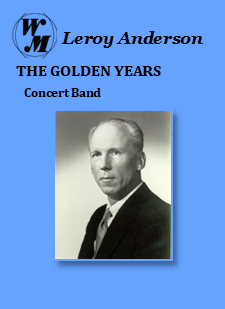
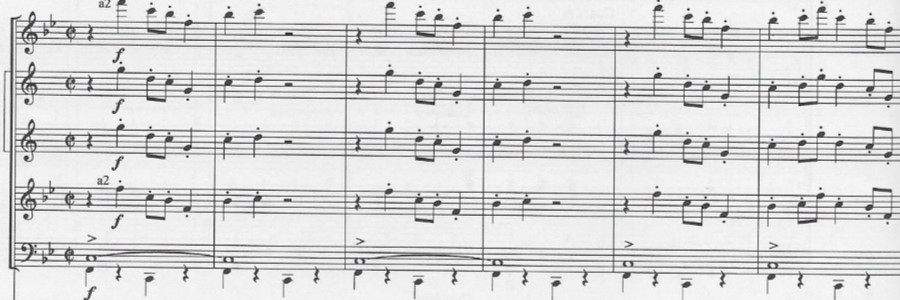
Leroy Anderson wrote and scored the majority of his compositions for full orchestra. For example: Sleigh Ride, Blue Tango, Serenata, Concerto in C for Piano + Orchestra, etc. Soon after publishing the original orchestral composition, Leroy Anderson would transcribe each composition for either concert band (wind band), string ensemble, piano or for some other instrumentation. Leroy Anderson also arranged music written by other composers. For example: A Christmas Festival, Irish Suite, Scottish Suite, Song of Jupiter, Seventy-Six Trombones, etc..
1. Orchestral Compositions;
2. Orchestral Arrangements;
3. Musical Theater compositions;
4. Vocal works;
5. Organ works;
6. Other compositions;
7. Transcriptions for Band;
8. Transcriptions for Piano;
9. Arrangements for Harvard University Band;
10. Notable arrangements by Others;
11. Compact Discs, DVD;
 |
 (2:16) Reference Article
  (2:48) Reference Article (2:56) Reference Article (2:36) Reference Article Reference Article Reference Article Reference Article Reference Article Reference Article (withdrawn by the composer, and released posthumously) Reference Article Reference Article Reference Article Reference Article Reference Article (3:20) Reference Article (2:29) (published posthumously)
(6:13) Reference Article (4:50) Reference Article Reference Article Reference Article Reference Article Reference Article (4:55) (published posthumously) Reference Article (3:28) (published posthumously) Reference Article (3:15) (published posthumously) Reference Article Reference Article (published posthumously) Reference Article (published posthumously) Reference Article Reference Article Reference Article (optional SATB chorus) Reference Article Reference Article (optional SATB chorus)
Reference Article Reference Article Reference Article
Reference Article Reference Article Reference Article Reference Article (Anderson's only work written for concert band) Reference Article Reference Article
Reference Article Reference Article (2:42) Reference Article
(2:48) Reference Article (2:56) Reference Article (2:36) Reference Article Reference Article Reference Article Reference Article Reference Article Reference Article (withdrawn by the composer, and released posthumously) Reference Article Reference Article Reference Article Reference Article Reference Article (3:20) Reference Article (2:29) (published posthumously)
(6:13) Reference Article (4:50) Reference Article Reference Article Reference Article Reference Article Reference Article (4:55) (published posthumously) Reference Article (3:28) (published posthumously) Reference Article (3:15) (published posthumously) Reference Article Reference Article (published posthumously) Reference Article (published posthumously) Reference Article Reference Article Reference Article (optional SATB chorus) Reference Article Reference Article (optional SATB chorus)
Reference Article Reference Article Reference Article
Reference Article Reference Article Reference Article Reference Article (Anderson's only work written for concert band) Reference Article Reference Article
Reference Article Reference Article (2:42) Reference Article
(original work is 9:00 long, Anderson created a shorter work (5:45) in 1952. Reference Article Reference Article (6:14) Reference Article
Reference Article
(published posthumously) (published posthumously) (seven carols, 11:42) (six carols, 12:21) (six carols, 10:45) Reference Article (2:12) (3:10) (2:35)
(4:55) (published posthumously)(3:28) (published posthumously)
(03:15)
(for beginning orchestra)
U.S. Coast Guard Band (Anderson's only work written for concert band)
Leroy Anderson conducting 47 of his compositions from recordings that were originally released on Decca LPs from 1953 to 1962.
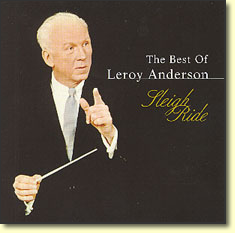
Leroy Anderson conducting 00 of his compositions from recordings that were originally released on Decca LPs from 1953 to 1962.
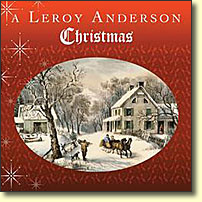
Leroy Anderson conducting his compositions and arrangements including: Sleigh Ride, A Christmas Festival, The Suite of Carols for String Orchestra, The Suite of Carols for Brass Choir, The Suite of Carols for Woodwind Ensemble. This is the first CD of the original 1959 recording on Decca, reduced to Monaural: A Christmas Festival (Decca DL 78925 (s); 1959)
Leonard Slatkin conducts the BBC Concert Orchestra in Leroy Anderson's Sleigh Ride, A Christmas Festival, The Suite of Carols for String Orchestra, The Suite of Carols for Brass Choir, The Suite of Carols for Woodwind Ensemble and 6 other works.
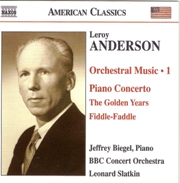
Leonard Slatkin conducts the BBC Concert Orchestra in 16 Leroy Anderson works including the Concerto in C for Piano and Orchestra with Jeffrey Biegel, pianist.
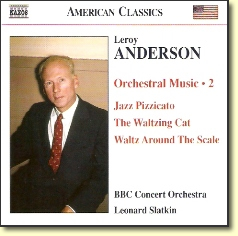
Leonard Slatkin conducts the BBC Concert Orchestra in 16 Leroy Anderson works including Forgotten Dreams, The Waltzing Cat, Song of the Bells and the Suite of Carols for String Orchestra.
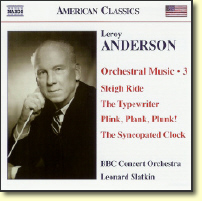
Leonard Slatkin conducts the BBC Concert Orchestra in 18 Leroy Anderson works including The Typewriter, Serenata, The Syncopated Clock, Suite of Carols for Brass Choir and arrangements of George Gershwin and Meredith Willson.
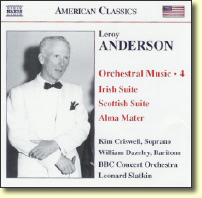
Leonard Slatkin conducts the BBC Concert Orchestra in 18 Leroy Anderson works including Irish Suite, the only recording of Scottish Suite, A Christmas Festival, and vocal recordings of Blue Tango, Belle of the Ball and Forgotten Dreams with Kim Criswell, soprano.
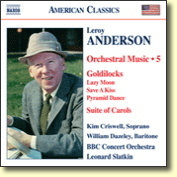
Leonard Slatkin conducts the BBC Concert Orchestra in 19 Leroy Anderson works including the Suite of Carols for Woodwind Ensemble and symphonic arrangements from his musical "Goldilocks" 3 of which with Kim Criswell, soprano and William Dazeley, baritone.

The one-hour long Public TV documentary and additional bonus performances is available as a DVD-only rental from Netflix. First Place "Gold Camera Award" - U. S. International Film and Video Festival, 2000
This section gives short descriptions and audio samples of 54 of Leroy Anderson's compositions.
| Alma Mater 1954 - Four short humorous scenes describing life at Harvard University. |
Arietta 1962 - A charming melody in classical two-part form, this was originally conceived as a duet for cello and viola. |
Baladette 1962 - A simple lyrical melody combined with a chromatic repeating counter melody. |
| Belle of the Ball 1951 - A brilliant fast waltz which recreates the atmosphere of the Viennese grand ballroom. |
Blue Tango 1951 - A Latin beat combined with blues figures and a lovely melody made Anderson's recording the #1 best seller of 1952. |
Bluebells of Scotland 1954 - This familiar folk melody takes on new freshness through the use of tonal color, and humor in Anderson's remarkable arranging skills. |
| Bugler's Holiday 1954 - Written for full orchestra, this is a virtuoso performance piece for three trumpets, popular at both Independence Day concerts in the U.S. and New Year's Day concerts worldwide. |
The Captains and the Kings 1962 - Suggested by a Kipling poem, this march shifts from 2/4 to 3/4, underscoring the uncertain fate of captains and kings. |
Chicken Reel 1946 - A traditional American dance tune developed into a brilliant concert piece with touches of humor and unexpected rhythmical variations which are hallmarks of Anderson's musical style. |
| China Doll 1951 - China Doll, as the title suggests, has a delicate, fragile melody, first played by the oboe, then by the entire orchestra. |
A Christmas Festival 1950 - A concert overture built upon traditional Christmas carols, beginning with Joy to the World and ending with Jingle Bells and O Come All Ye Faithful. This is the 1959 Stereo recording of the original 1950 full-length version as recorded by Leroy Anderson. |
Clarinet Candy 1962 - A brilliant showpiece for four clarinets in the spirit of Bugler's Holiday. |
| Classical Jukebox 1950 - Based on the 50's hit, Music! Music! Music!, this jukebox plays famous classical pieces, with a section that features a stuck needle that plays a phrase over and over. First performed and recorded by the Boston Pops. |
Concerto in C for Piano 1953 - Withdrawn by the composer and released posthumously, the piano concerto is an interesting and very accessible work with a distinctly American and Leroy Anderson flavor. |
Fiddle-Faddle 1947 - Anderson first chose the title and then wrote this modern virtuoso piece for the string section of the orchestra, inspired by Niccolo Paganini's piece titled "Perpetuo Moto". |
| First Day of Spring 1954 - A sweeping melody with lush strings and a pastoral oboe. |
Forgotten Dreams 1954 - This piece has always been the favorite Anderson piece in England. Anderson plays the solo piano part. |
Girl in Satin 1953 - A lovely, languorous melody in tango rhythm. |
| The Golden Years 1962 - Warm romanticism with a triumphant melody. |
Goldilocks - I Never Know When 1962 - This is a timeless treatment of the evergreen "torch" song. |
Goldilocks - Lady in Waiting Ballet Music 1959 - Based on a charming ballet sequence in the show. |
| Goldilocks - Pyramid Dance 1960 - A brilliant finale which satirized the making of silent movies. This is also published for band with optional chorus. |
Goldilocks - Shall I Take My Heart 1962 - Another lovely melody by Anderson. |
Goldilocks - Town House Maxixe 1962 - Anderson's version of the maxixe, an ancestor of the samba, and popular around 1912. |
| Irish Suite - The Irish Washerwoman 1947 - A picturesque orchestral setting of Irish folk music, consisting of six movements. The first movement, "The Irish Washerwoman," is a double jig, the sprightliest of dances, and is enhanced with a brilliant and infectious orchestral setting. |
Irish Suite - The Minstrel Boy 1947 - With somber orchestral coloring, this is a slow march over a basso ostinato. Distant trumpets and drums punctuate the melody. |
Irish Suite - The Rakes of Mallow 1947 - Evokes the carousing and rioting of the young bloods of Mallow. |
| Irish Suite - The Wearing of the Green 1949 - Treated as a scherzo alternating between strings, woodwinds and brass. |
Irish Suite - The Last Rose of Summer 1947- A solo violin is featured. The background is provided by strings and harp, reinforced only by horns and trombones. |
Irish Suite - The Girl I Left Behind Me 1949 - A haunting song with an ingenious contrapuntal effect near the end. |
| Jazz Legato 1938 - Played with the bow in legato style, this was written as a companion piece for Jazz Pizzicato. Together the two were just long enough to fill one side of a three-minute 78 r.p.m. record. |
Jazz Pizzicato 1938 - A study in jazz rhythms played pizzicato by the strings, this was Anderson's first composition and an immediate hit. |
Lullaby of the Drums 1970 - Posthumously published, this features timpani, snare and bongo drums in a somnolent mood. |
| March of the Two Left Feet 1970 - Posthumously published. The idea for writing a "clumsy" march came to Anderson after he read a story with this title by P.G. Wodehouse. |
Old MacDonald Had a Farm 1947 - A humorous, winning arrangement first played and recorded by the Boston Pops. |
The Penny-Whistle Song 1951 - Three flutes are featured. This merry song speaks - and sings - for itself! |
| The Phantom Regiment 1951 - A nameless body of soldiers approaches from the distance to the sound of trumpets. As they draw nearer the music grows louder and louder, and finally they march away into the distance. |
Plink, Plank, Plunk! 1951 - The string section plays pizzicato throughout this entire piece. This was the theme for the televised game show, "I've Got a Secret," for twenty-four years. |
Promenade 1945 - Contrasts a brisk walking theme, first heard on solo trumpet, with a flowing middle theme carried by the strings. |
| Sandpaper Ballet 1954 - Recreates the old days of vaudeville when soft-shoe dancers spread sand on stage. Three grades of sandpaper are used. |
Saraband 1948 - The 18th century sarabande dance is updated with the flavor of a foxtrot in this combination of past and present. |
Serenata 1947 - The melodic and harmonic material shift in texture, key and mode, as an infectious Latin rhythm is played throughout. This has entered the jazz repertoire, being adapted by both vocalists and instrumentalists. |
| Sleigh Ride 1948 - The Christmas classic was composed during a July heat wave while Anderson lived in Woodbury, Connecticut. Words were added by Mitchell Parish in 1950, who also added words to six other Anderson works after they became popular. |
Song of Jupiter 1951 - The aria "Where'er You Walk", from Handel's oratorio "Semele", has been transcribed preserving the style and character of Handel's music. |
Song of the Bells 1951 - The middle section of this waltz contains something rarely heard: a duet between chimes and bells. The flowing musical themes show why Anderson has been called one of our greatest melodists. |
| Suite of Carols for Brass Choir 1955 - Selections: While by my Sheep; In Dulci Jubilo: Lo, How a Rose E'er Blooming: I Saw Three Ships: From Heaven High I Come to You; We Three Kings of Orient are; March of the Kings. |
Suite of Carols for String Orchestra 1955 - Anderson carefully chose six carols and gave them rich, typically Anderson string writing. Selections: Pastores a Belen; It Came Upon the Midnight Clear; O Little Town of Bethlehem; Bring a Torch Jeanette, Isabella; Away in a Manger; Wassail Song. |
Suite of Carols for Woodwind Ensemble 1955 - Selections: Angels in Our Fields; O Sanctissima; O Come, O Come Emmanuel; O Come Little Children: Coventry Carol; Patapan. |
| Summer Skies 1953 - An unabashed romance, the chromatic nature of the tune notwithstanding, this conveys a strong nostalgic urge, a relaxed happiness. |
The Syncopated Clock 1945 - Written while Anderson was assigned to the Pentagon in Washington, D.C. This piece was the theme music for "The Late Show" on WCBS-TV in New York City for over 25 years. |
Ticonderoga March 1945 - Leroy Anderson's only work written for concert band. |
| A Trumpeter's Lullaby 1949 - Written at the request of Roger Voisin, then principal trumpet of the Boston Pops Orchestra. He asked for a trumpet work that wasn't the usual loud trumpet piece. In this recording Harry Freistadt plays the trumpet solo. |
The Typewriter 1950 - A famous piece in which an actual typewriter is the solo "instrument", this continues to be used as a theme on radio, usually for news broadcasts. |
The Waltzing Cat 1950 - Anderson has described an imaginary animal that might be the brother of Puss in Boots. Like a stately cavalier, this feline gentleman dances to a graceful melody constructed on the strings playing the meowing of a cat. |
SITE MAP
leroyanderson.com
Also visit the official website
of the
Leroy Anderson Foundation
established by his family.